

MARIUPOL
The photo shows the Arch in Mariupol City Park
Photo source: ВЧАСНО

This material is available in your native language.
We have prepared this content for you to explore the history of Mariupol. Discover the city’s architectural heritage and cultural identity, preserved within our archive.
MARIUPOL Цей матеріал можна переглянути вашою рідною мовою.
Ми підготували цей контент, щоб ви могли дослідити історію Маріуполя. Відкрийте для себе архітектурну спадщину та культурний код міста, що зберігаються в нашому архіві.
МАРІУПОЛЬ Този материал може да бъде разгледан на вашия роден език.
Подготвихме това съдържание, за да можете да изследвате историята на Мариупол. Открийте архитектурното наследство и културната идентичност на града, съхранени в нашия архив.
МАРИУПОЛ THE CITY OF STEEL AND THE SEA
Mariupol, a city of regional significance in the Donetsk Oblast and the administrative center of the district and community of the same name, has served as the main maritime gateway to eastern Ukraine for centuries.
As the southern outpost of the Donetsk region, this city has become a crossroads where the Cossack freedom of the Kalmius Palanka, the unique culture of Greek immigrants, and major metallurgical projects—which shaped the country’s “steel heart”—converge. In the fabric of regional memory, Mariupol emerges not merely as an industrial center, but as a complex sociocultural organism where maritime romance, the high art of Arkhip Kuindzhi, and the tragic resilience of the defenders of Ukrainian statehood coexist.

The Flag of Mariupol
Wikipedia

The Coat of Arms of Mariupol
Wikipedia
Mariupol’s status as a key logistics and economic hub is cemented by its strategic location at the mouth of the Kalmius River. The city lies on the shores of the Sea of Azov, a factor that has historically shaped its development as a port center and resort area. The city covers an area of 244 square kilometers, and its average elevation is 67 meters above sea level, offering a unique blend of steppe and coastal landscapes.

General Information
Official name: Mariupol (since 1780—present). Country: Ukraine.
Region: Donetsk Oblast.
District: Mariupol District (administrative center).
Municipality: Mariupol City Territorial Community.
Status: City (since 1779).
Date of foundation: 1778 (officially), Cossack outpost of Domakha (16th century).
Region: Donetsk Oblast.
District: Mariupol District (administrative center).
Municipality: Mariupol City Territorial Community.
Status: City (since 1779).
Date of foundation: 1778 (officially), Cossack outpost of Domakha (16th century).
Geographic and technical data
City area: 244.0 km².
Municipality area: 404.2 km².
Elevation: 67 meters (average).
ZIP code: 87500 (central), range 87501–87557.
KATOTTG code: UA14140050010029262.
Municipality area: 404.2 km².
Elevation: 67 meters (average).
ZIP code: 87500 (central), range 87501–87557.
KATOTTG code: UA14140050010029262.


Population
The city’s population remained stable until the start of the large-scale invasion:
As of January 1, 2020: 457,439 people.
As of January 1, 2021: 452,542 people.
As of January 1, 2022: 425,681 people.
Total population of the community (2021):
552,660 residents (including IDPs).
As of January 1, 2020: 457,439 people.
As of January 1, 2021: 452,542 people.
As of January 1, 2022: 425,681 people.
Total population of the community (2021):
552,660 residents (including IDPs).

A Historical Retrospective
From the Cossack settlement of Domakha to the Greek polis
THE CITY OF STEEL AND THE SEA
The history of Mariupol dates back to the 16th century, when the Cossack winter encampment of Domakha was established on the right bank of the Kalmius River.
In 1611, it became the center of the Kalmius Palanka—the eastern outpost of the Zaporizhian Host. After the dissolution of the Sich in 1775, these lands were transformed into the Kalmius County, and in 1778, the town of Pavlovsk was founded.

Mariupol. Old Pier
Photo source: Wikipedia

Map of Mariupol in 1826
Photo source: Wikipedia
A true demographic and cultural revolution took place in 1778–1780 during the resettlement of Christians (Greeks, Armenians, Georgians) from Crimea to the Azov region. Led by Metropolitan Ignatius, they founded modern-day Mariupol, bringing the name “City of Mary” and Crimean place names to the surrounding villages. The city quickly became a major center for grain trade, leading to the opening of consulates of foreign states.
At the end of the 19th century, the railway and the construction of a deep-water port (1889) paved the way for foreign investment. The establishment of the Nikopol and Providance factories transformed the merchant town into an industrial giant on a European scale.

The Nikopol factory in Mariupol
Photo source: Mariupol Local History Museum
THE CITY OF STEEL AND THE SEA
The Soviet Period and Steel Construction

Azovstal in Soviet Times
Photo source: facebook.com/evgeny.mushkin.5
In the 1930s, the Azovstal Steel Works was established on the left bank of the Kalmius River, becoming a symbol of industrialization. During World War II, the city endured German occupation and the terrible tragedy of the destruction of the Jewish community, whose spiritual leader, Metropolitan Ignatius, was laid to rest in the Haralampiivsky Cathedral until its destruction. From 1948 to 1989, the city bore the name of the Soviet official Zhdanov, but with the collapse of the USSR and the restoration of Ukraine’s independence, it regained its historical name.
The Cultural Identity of Mariupol
Kuindzhi's Legacy and the Code of Resilience
THE CITY OF STEEL AND THE SEA
Mariupol holds a unique place on the world’s cultural map as the birthplace of Arkhip Kuindzhi—the brilliant “master of light.”
The art museum named after him housed a unique collection of documents, including the parish registers detailing his marriage to Vera Shapovalova and a copy of his birth certificate from 1841. Kuindzhi’s work was deeply connected to the Azov region, as reflected in his famous painting “The Milky Way in Mariupol” (1875).

The Milky Way in Mariupol
Painting by Arkhip Kuindzhi

Water tower
Photo source: Ukrinform
Another cornerstone of the city’s culture is the legacy of city architect Viktor Nielsen. Based on his design, the 33-meter-tall Water Tower was built in 1910, similar to the one he had previously constructed in Rybinsk in 1899. The tower served a 21-kilometer water supply system and became a symbol of engineering excellence.
Nielsen also built his own Art Nouveau-style home, featuring a relief of a “weeping nymph” dedicated to the memory of his daughter, who died of typhus. The “Houses with Spires” (1953) on Liberation Square, designed by Kyiv architect L. Yanovitsky (Miskbudproekt Institute), also stand out in the city and represent the last example of Stalinist neoclassicism in the city. Both buildings are adorned with stucco moldings, pilasters, and bay windows.

“Houses with Spires” (1953)
Photo source: MRPL.CITY

The “Boriviter” Mosaic (1967)
Creator: Alla Oleksandrivna Gorska
Soviet mosaics from the “Thaw” period are of particular artistic value. The mosaic “Boriviter” (1967) was created by the dissident artist Alla Horska in collaboration with Viktor Zaretsky for the interior of the “Ukraine” restaurant. When the Soviet authorities ordered the work to be destroyed, the artists hid it behind a false wall, thanks to which the mosaic was discovered during renovations in 2008.
Another of her works — “The Tree of Life” — is also considered a masterpiece of monumental art. The “Metallurgists” mural is a landmark of Mariupol, and near the sea stood Viktor Ponomarev’s “Tourism and Recreation” mosaic, beloved by many.

“The Tree of Life” (1967)
Creator: Alla Oleksandrivna Gorska
“Houses with Spires” (1953)
- Source: Wikipedia
- Source: MRPL.CITY
- Source: Landmarks of Ukraine
For the people of Mariupol, their connection to the sea and to labor is a source of particular pride. In 2016, Serhiy Rodionov, together with type designer Andriy Shevchenko, developed the city’s brand, “#ТутВарто.” The logo combines Yuhim Kharabet’s anchor with a stream of steel flowing from a metallurgical ladle. In the typography, the letters “Р,” “П,” and “Л” are stylized in the Greek style, evoking the community’s roots.
THE CITY OF STEEL AND THE SEA
Arts and Education Hub

Priazovsk State Technical University
Photo source: PSTU
Before the war, Mariupol had developed into a center of higher education and culture. The Mariupol State Technical University (whose first building was designed by Nielsen as a diocesan school) and the Mariupol State University trained professionals and fostered international cooperation, making the city a showcase for successful European reforms in the Azov region.
The city's industrial landmarks
The Metallurgical Ridge and the Sea Gate
THE CITY OF STEEL AND THE SEA
Mariupol is a city of titanic labor, where railroad tracks and port cranes shape the landscape.

“Azovstal” — the legendary giant and stronghold of the Azov region
Azovstal Iron and Steel Works
It was founded on February 2, 1930, following a decision to build a new plant at the mouth of the Kalmius River. The budget allocated 292 million currency units for the construction of this industrial giant.
On the eve of World War II, the plant was setting world records: in May 1939, blast furnace No. 3 produced 1,614 tons of pig iron per day, and on August 5 of that year, open-hearth furnace No. 5, with a capacity of 400 tons—the largest in Europe—began operations. In the fall of 1941, the equipment was evacuated to the Urals, and in 1943, the plants were blown up by retreating German troops.
It was founded on February 2, 1930, following a decision to build a new plant at the mouth of the Kalmius River. The budget allocated 292 million currency units for the construction of this industrial giant.
On the eve of World War II, the plant was setting world records: in May 1939, blast furnace No. 3 produced 1,614 tons of pig iron per day, and on August 5 of that year, open-hearth furnace No. 5, with a capacity of 400 tons—the largest in Europe—began operations. In the fall of 1941, the equipment was evacuated to the Urals, and in 1943, the plants were blown up by retreating German troops.
Following extensive reconstruction in 1944–1945, the plant became the first in the USSR to master the production of 25-meter-long railroad tracks, which were later used to lay two-thirds of the railways in the former Soviet Union. In 1953, the plant began producing its own sinter, becoming a full-cycle enterprise. The launch in 1973 of the unique “3600” rolling mill—in the creation of which 214 plants from Germany, Poland, Hungary, England, and Austria participated—became a true marvel of engineering.

“Azovstal” — the legendary giant and stronghold of the Azov region

“Azovstal.” August 27, 2021.
Photo source: Wikipedia
By 2022, Azovstal covered an area of 11 square kilometers (equivalent to 4.5 times the size of Monaco). The underground section of the plant consisted of five levels with tunnels totaling over 20 kilometers in length. A system of 36 bomb shelters could accommodate up to 12,000 people. Before the full-scale invasion began, the plant accounted for up to 10% of Ukraine’s GDP, had a capacity of up to 5 million tons of steel per year, and produced unique military-grade thick-gauge rolled steel ranging in thickness from 6.5 mm to 200 mm.
“Azovstal” — the legendary giant and stronghold of the Azov region
Photos of a Modern Full-Scale War

Mariupol Metallurgical Plant — a high-tech flagship
Photo source: Mind.ua
Mariupol Metallurgical Plant
It was the third-largest metallurgical plant in Ukraine. The plant’s production facilities included a unique sintering plant with 12 sintering machines (capacity of 12 million tons of sinter), 4 blast furnaces (4.3 million tons), 3 converters (3.7 million tons), and rolling mills (Slab Mill 1150, Sheet Rolling Mill 1700).
It was the third-largest metallurgical plant in Ukraine. The plant’s production facilities included a unique sintering plant with 12 sintering machines (capacity of 12 million tons of sinter), 4 blast furnaces (4.3 million tons), 3 converters (3.7 million tons), and rolling mills (Slab Mill 1150, Sheet Rolling Mill 1700).
In the 2000s, the plant consistently posted strong results, producing up to 6 million tons of pig iron, 7 million tons of steel, and 5.3 million tons of rolled steel annually. Even during economic crises, production remained robust: in 2013, 4.269 million tons of steel and 4.606 million tons of finished rolled steel were produced, and in 2018, 3.242 million tons of steel.
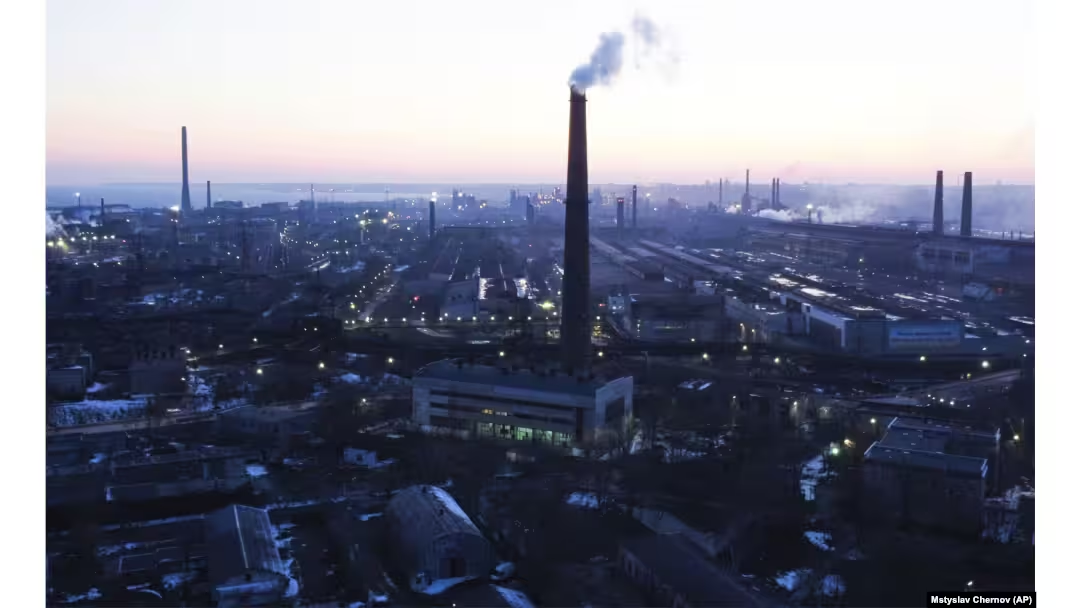
Mariupol Metallurgical Plant — a high-tech flagship
Photo source: Radio Free

Mariupol Metallurgical Plant — a high-tech flagship
Photo source: gmk.center
In November 2019, the company completed a major overhaul of the “1700” sheet rolling mill, investing $114 million, which enabled it to increase its hot-rolled coil production capacity to 2.5 million tons per year. The plant employed more than 14,000 workers.
Mariupol Metallurgical Plant — a high-tech flagship
Photos of a Modern Full-Scale War

The Mariupol Commercial Seaport—a gateway to the world's oceans
Photo source: gmk.center
Mariupol Commercial Sea Port.
The largest port on the Sea of Azov and one of the three largest in Ukraine, it had a potential cargo throughput of 15 million tons per year. Prior to the events of 2014, the port was steadily approaching this mark, handling raw materials and finished metallurgical products. After the war began in Donetsk Oblast, figures temporarily declined; however, by the time of the full-scale invasion, the port had confidently reached a throughput of approximately 7 million tons.
The largest port on the Sea of Azov and one of the three largest in Ukraine, it had a potential cargo throughput of 15 million tons per year. Prior to the events of 2014, the port was steadily approaching this mark, handling raw materials and finished metallurgical products. After the war began in Donetsk Oblast, figures temporarily declined; however, by the time of the full-scale invasion, the port had confidently reached a throughput of approximately 7 million tons.
In 2020, the port’s cargo turnover totaled 6.22 million tons (an increase of 449,000 tons compared to 2019). Exports totaled 5.26 million tons, while imports amounted to 555,000 tons (including 407,800 tons of construction materials and 142,900 tons of coal). Coastal shipping of ferrous metals and coal totaled 388,300 tons, with the resumption of coastal shipping of slabs and pig iron to the Port of Pivdennyi.

The Mariupol Commercial Seaport—a gateway to the world's oceans
Photo source: gmk.center

The Mariupol Commercial Seaport—a gateway to the world's oceans
Photo source: rail.insider
The main destination countries were Italy (2.237 million tons), Turkey (1.422 million tons), the United Kingdom (315,000 tons), Lebanon (86,000 tons), Morocco (82,000 tons), and France (81,000 tons). The port was home to the modern grain terminal “UkrTransAgro,” which was already operating at full capacity as of February 23, 2022, preparing for the shipment of the new season’s grain.
Cultural Heritage
Landmarks
THE CITY OF STEEL AND THE SEA
Mariupol is rich in sites that blend various archaeological and architectural eras — dating back to the distant past of the Neolithic period. Its landmarks embody the refined European charm of the old Azov region and reflect the deep cultural layers of each historical era.
Cultural Heritage
Landmarks
Landmarks
Ancient Layers of History: An Egyptian-era Crypt and a Neolithic Burial Ground
The Azov region harbors a centuries-old history of human civilizations. During archaeological excavations in 1930, conducted prior to the construction of Mariupol’s first five-story residential building on the Kamburov plot, a unique pit-type burial chamber was discovered in the city’s historic center. The burial, dating to the mid-2nd millennium BCE, belonged to people who were contemporaries of Ancient Egypt but lived on the shores of the Azov Sea. In the crypt with a stepped roof, the remains of twelve individuals and household items were discovered, as well as rare coins depicting a boat and a human figure inside it.

Excavations at the Mariupol burial ground. 1930
Photo source: Wikipedia

A fragment of a burial mound dating back approximately 6,000 years.
An exhibit at the Mariupol Local History Museum
An exhibit at the Mariupol Local History Museum
Photo source: texty.org.ua
The discovery of the Mariupol Neolithic burial ground, estimated to be approximately 6,000 years old, held a special place in the city’s historical record. This unique find from the burial ground was uncovered in the summer of 1930 during preparatory excavation work for the construction of the Azovstal steelworks. The find contained invaluable anthropological material, but it was completely destroyed in March 2022 as a result of the bombing of the local history museum.
Cultural Heritage
Landmarks
Landmarks
Mariupol Local History Museum
Founded in 1920 (and officially opened in 1923 at the initiative of local residents), the Mariupol Local History Museum was the oldest museum institution in the Donetsk Oblast. The museum complex on Georgievskaya Street, under the direction of the city authorities, comprised three notable branches: the local history museum itself (building No. 20), the Arkhip Kuindzhi Art Museum (building No. 58), and the Museum of Folk Life (building No. 55), which had been showcasing the culture and way of life of the ethnic groups of the Azov region since 1989.
The museum’s total collection numbered over 50,000 priceless exhibits. In March 2022, the museum building on Georgievskaya Street—which had survived a fire in 1943 and was rebuilt by the Zhdanovzhilbud trust in 1962 according to a design by Giprograd—was destroyed as a result of intense shelling.
The museum’s total collection numbered over 50,000 priceless exhibits. In March 2022, the museum building on Georgievskaya Street—which had survived a fire in 1943 and was rebuilt by the Zhdanovzhilbud trust in 1962 according to a design by Giprograd—was destroyed as a result of intense shelling.

Mariupol Local History Museum (MAMU)
Photo source: Mariupol Local History Museum
Cultural Heritage
Landmarks
Landmarks
The Arkhip Kuindzhi Art Museum

A.I. Kuindzhi Art Museum
Photo source: Magnolia TV
The museum opened in 2010 as the first phase of a major city-wide arts project. It is housed in a unique historic building dating from 1902, constructed in the Northern Art Nouveau style, which once belonged to the estate of Vasyl Hyatsyntov. The museum’s exhibition, spread across ten halls covering 300 m², presented the amazing world of the life and work of the outstanding landscape painter Arkhip Kuindzhi. It housed the sketches “Autumn. Crimea” and “Elbrus,” as well as the sketch “Red Sunset,” which had been transferred from the Hermitage. A particularly sacred exhibit was a metal baptismal font from the former Church of the Nativity of the Blessed Virgin Mary, in which the future artist was baptized in 1841.
The art museum's collection included over two thousand exhibits. Among them were paintings by Kuindzhi’s contemporaries—Ivan Aivazovsky (“Near the Shores of the Caucasus”), Mykola Dubovsky, a sculptural bust by master craftsman Volodymyr Beklemishev, as well as paintings by prominent 20th-century Ukrainian artists: Tetyana Yablonska, Mykola Hluschenko, Mykhailo Derehus, Serhii Shyshko, Mykola Bendryk, Ivan Marchuk, and many local artists. A unique part of the collection consisted of a collection of 19th- and 20th-century bookplates and the medallic art of Yukhim Kharabet. On March 21, 2022, the museum building was completely destroyed by a direct hit from a Russian aerial bomb.

The Arkhip Kuindzhi Art Museum
Photos taken before and during the current full-scale war
Cultural Heritage
Landmarks
Landmarks
“Hotel Continental” Contemporary Art Center

Azovstal Steelworks Cultural Center
Photo source: Wikipedia
The elegant three-story Continental Hotel was built between 1887 and 1910 in the eclectic style. The first phase was built by Italian entrepreneur Tommaso in 1898, and in 1910, a three-story wing was added to the building, featuring a luxurious auditorium, a foyer, and technical facilities. The hotel was considered the main hub of cultural life for Mariupol’s intelligentsia, housing the city’s first electrified printing press, operated by the Goldrin brothers. After World War II, the building served as the Azovstal Plant’s Palace of Culture, and later as the Molodizhny Cultural and Sports Complex. In 2019, the “Hotel Continental” Center for Contemporary Art opened in the building. During the siege, the building’s basement served as a shelter for hundreds of civilians, and on April 20, 2022, the palace was almost completely destroyed by fire as a result of artillery shelling by the occupying forces.
«Hotel Continental»
Before and after the russian occupation
Cultural Heritage
Landmarks
Landmarks
Choral Synagogue
Founded in 1882, the Choral Synagogue is one of the oldest Jewish landmarks in Eastern Ukraine. The construction of this grand synagogue was facilitated by a royal charter and the expansion of rights for the Jewish community, whose first members arrived in the city in the 1820s. The synagogue was a neoclassical brick rectangular building measuring 25 by 20 meters, featuring Doric pilasters, graceful arches, and window panels. It was separated from the street by a wrought-iron fence on a high foundation with columns adorned with balls. During the Nazi occupation of 1941–1943, the building was destroyed, and during the Soviet era, the surviving wing was used as a medical school building and a tuberculosis dispensary. In the 1990s, the roof of the main building collapsed under the weight of snow, leaving only the facade walls and the arched gate in a state of disrepair.

The Choral Synagogue of Mariupol, Mariupol, 18 Georgievskaya Street
Photo source: Wikipedia
Cultural Heritage
Landmarks
Landmarks
Gamper House

Gamper House
Photo source: Google Maps
This unique Neo-Gothic architectural landmark consisted of two parts: a classic two-story brick mansion measuring 8 by 8 meters, built in 1897 by the merchant Shneiderovich, and a Neo-Gothic wing-castle added later. The construction and renovation of this magnificent building, featuring a three-tiered spire, lancet windows, and lavish brickwork, were carried out at the initiative of the Hampers family. Serhii Fedorovych Hamper, a prominent forensic expert and public figure, lived here and saw patients in the doctor’s wing. After the revolution, the building was converted into a Soviet communal apartment. The estate was severely damaged and partially destroyed by a direct hit from an aerial bomb on April 12, 2022.
Gamper House
Before and after the russian occupation
Cultural Heritage
Landmarks
Landmarks
City Park
The city’s oldest green space was established in 1864 on a picturesque hill overlooking the Sea of Azov. The garden was a favorite spot for Mariupol residents to take a stroll. It was here on July 15, 1875, that the first 100 kerosene lamps were installed to illuminate the city’s avenues at night; by 1914, their number had grown to 686. A public bathhouse, opened in 1867, also operated here, and in 1871, the paving of the adjacent squares and streets began.

City Park
Caption: City Park. Founded in 1863.
Caption: City Park. Founded in 1863.
Photo source: Landmarks of Ukraine
Mariupol City Park
A snapshot of modern full-scale war
The Challenges of Today
A Hero City and the Tragedy of Resilience
THE CITY OF STEEL AND THE SEA
The ongoing tragedy in Mariupol began in 2014 and escalated into a global humanitarian disaster in 2022.
On March 16, 2022, the occupying forces’ air force dropped two 500-kilogram bombs on the Mariupol Drama Theater, where up to 1,000 civilians were taking shelter. Despite the word “CHILDREN” written on the building, the theater was destroyed. The number of victims of this war crime remains unknown and is estimated to be between 300 and 600 people.

Donetsk Academic Regional Drama Theater in Mariupol
Photos taken before February 24, 2022
Photos taken before February 24, 2022
Photo source: Wikipedia
The Mariupol Drama Theater Building
Photos of the destruction

Photo source: Ukrinform

Donetsk Academic Regional Drama Theater in Mariupol
Photo taken during the occupation
Photo taken during the occupation
Photo source: Village
Later, the occupiers demolished what remained of the building, covering the remains of the victims with concrete and rebuilding the walls with red brick to conceal evidence of the crime. The documentary play “The Mariupol Drama” (premiering September 16, 2022), based on eyewitness accounts, is dedicated to this tragedy.
THE CITY OF STEEL AND THE SEA
Today, Alla Gorskaya’s unique mosaics (“Boriviter” and “Tree of Life”) have been severely damaged by shelling.
#SaveMariupolHeritage — The Lviv-based studio Skeiron conducted laser scanning and created 3D models of the Drama Theater and other landmarks in the city.
“Spatial Archive” — a research project involving Forensis and Forensic Architecture that documents the destruction and crimes in the city.
Cultural Diplomacy — a book of aerial photographs of Mariupol is being distributed worldwide and is even preserved at the Antarctic research station “Akademik Vernadsky.”
The “YaMariupol” project and the recreation of the “Boriviter” mosaic by 15 contemporary artists, including Alla Horska’s granddaughter Olena Zaretska.
“Spatial Archive” — a research project involving Forensis and Forensic Architecture that documents the destruction and crimes in the city.
Cultural Diplomacy — a book of aerial photographs of Mariupol is being distributed worldwide and is even preserved at the Antarctic research station “Akademik Vernadsky.”
The “YaMariupol” project and the recreation of the “Boriviter” mosaic by 15 contemporary artists, including Alla Horska’s granddaughter Olena Zaretska.
Mariupol – City of Heroes
Mariupol has been awarded the honorary title of Hero City of Ukraine. Its spirit of steel and sea will never be destroyed, and the spirit of Azovstal will forever be etched into the history of global resistance.
Далі матеріал не стосується міста. Оновлення
Галерея міста
Місто Білого Золота
МІСТО КОКСОХІМІКІВ
Галерея міста
ДП "АРТЕМСІЛЬ"
Джерело: Суспільне
Стела при в'їзді у Соледар
Джерело: Вікіпедія
Новий Рік у шахті
Джерело: Туризм по-українські
Концертна зала у шахті
Джерело: На Пенсії
Видобуток солі
Джерело: Inclusive Travels in Ukraine
Підземні Шахти
Джерело: Dreamstime
Козаки у шахті
Джерело: Діти в місті Харків
Сіль (станція)
Джерело: Вікіпедія
МАЄТЕ МАТЕРІАЛ ПРО СОЛЕДАР?
ДОПОМОЖІТЬ ЗБЕРЕГТИ ІСТОРІЮ
СТАНЬТЕ СПІВАВТОРОМ
Поділіться цікавою інформацією, історичними фактами або фотографіями. Ваші знахідки допоможуть зробити наш архів повнішим.
ДОСЛІДЖУЙ ДОНЕЧЧИНУ ЗАРАЗ
ДОНЕЧЧИНА БУДЕ ВІЛЬНОЮ
Культурна мозаїка
Збираємо докупи фрагменти минулого та теперішнього, щоб побачити цілісний образ регіону в деталях.
Візуальна пам'ять
Фотоархів, що фіксує миті трансформації: від індустріальної величі до шрамів війни та перших паростків відновлення.
Source of the photo or material
The source of the material or a link to it is not available for security and privacy policy reasons.